
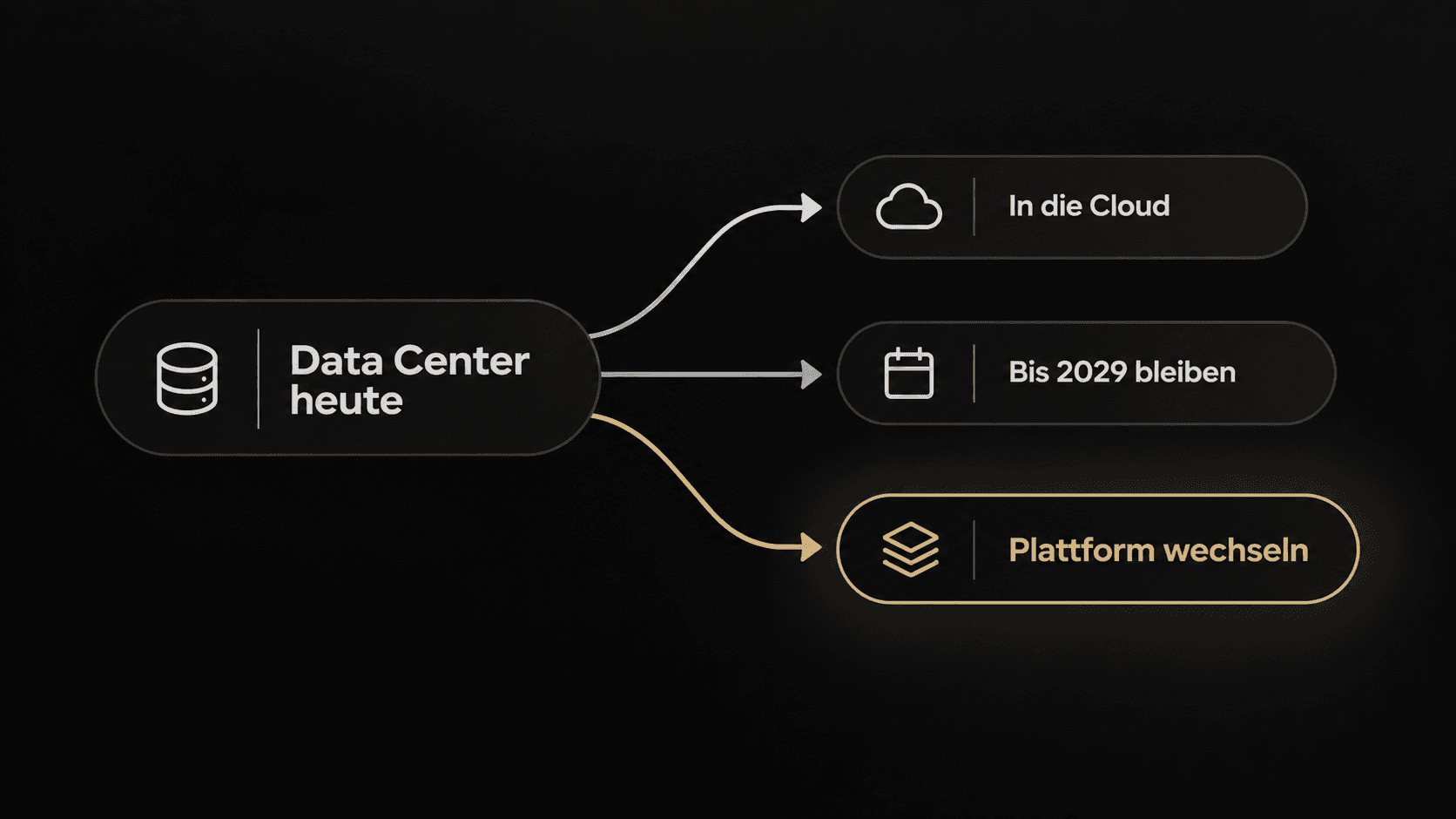
Atlassian is moving its Data Center products to read-only on 28 March 2029. Jira Software, Jira Service Management, Confluence, Bamboo and Crowd are affected. Bitbucket remains available. Companies have three paths: migrating to Atlassian Cloud, running on until the final purchase date in 2028, or moving to a different platform. For Swiss companies with requirements on data sovereignty, the third path is worth a serious look.
In this post
- The full timeline up to end of life in 2029
- What exempts Bitbucket and Jira Align from the retirement
- Three questions that decide your migration
- When Collabase comes into question as the Swiss alternative
- How a proof of concept actually runs
The timeline
| Date | What happens |
|---|---|
| 17 February 2026 | Around 15% price increase on Data Center licences |
| 30 March 2026 | Sales stop for new customers |
| 30 March 2028 | Sales stop for existing customers (no new licences, no more extensions) |
| 28 March 2029 | End of life. Instances run in read-only mode. Marketplace apps stop working. |
Support and security updates continue until the final date. For customers with particular requirements, Atlassian states that it offers extended maintenance beyond 2029, to be agreed individually.
Two exceptions matter: Bitbucket Data Center is not affected by the EOL. From mid-2026 Atlassian will provide a hybrid licence that allows Bitbucket Data Center and Bitbucket Cloud to be used in parallel. Jira Align also continues.
Why this is more than a licensing question
For many Swiss companies, Data Center was the on-premise option for Jira and Confluence. If you meet regulatory requirements on data storage, run your own infrastructure or have Marketplace apps deeply embedded in your processes, you are facing a strategic decision. Migrating to Atlassian Cloud is the path Atlassian recommends. For some customers it is also the right one. For others, a second look pays off.
Three questions decide the choice:
Data storage. Where may and where should your data sit? Atlassian Cloud now offers data residency for Switzerland, though only on the Standard, Premium and Enterprise plans and only for core products. For Marketplace apps you have to check app by app whether they support data residency.
App landscape. Which Marketplace apps do you use? Not every Data Center app has an equivalent in the cloud. Custom integrations with direct database access no longer work in the cloud.
Process maturity. How deeply are your workflows rooted in Jira and Confluence? A migration is rarely a pure lift and shift. It is an occasion to review inherited complexity and clear it up.
What makes sense now
A realistic plan starts with taking stock: active projects, apps in use, critical integrations, number of users, actual intensity of use per team. On that basis you can judge whether a cloud migration by 2029 is feasible, whether extending Data Center use until 2028 makes sense, or whether replacing it with another platform is worth considering.
The third option deserves more attention than it usually gets. If the change is coming anyway, you can use the occasion to ask the tooling question afresh: what do we actually need? Where has the toolbox grown bloated over the years? And does an American cloud provider still fit our requirement for data sovereignty?
Collabase as the Swiss alternative
Collabase was built for exactly this reassessment. As a Swiss B2B collaboration platform, we cover the applications that many companies use Confluence and the project and portfolio side of Jira for today.
The three core applications at a glance:
- Docs. The direct candidate for everything Confluence is used for today. Knowledge pages, meeting minutes, documentation, collaborative editing.
- Projects. Project and portfolio management focused on overview, progress and collaboration across teams.
- Registry. Structured management of assets, inventories and reference data that projects and processes need again and again.
Alongside them, AI and Automation come as cross-cutting capabilities of the platform rather than bolted-on extras. And three supplementary applications for intranet, time tracking and test management, where that additionally makes sense in a customer's context.
Two things we deliberately do differently:
Data held in Switzerland. Not as a configurable option but as a precondition. Data and information processing takes place entirely in Switzerland.
Concentration on the core. Collabase is not a kit of 60 specialised apps with hundreds of Marketplace extensions. The aim is that the most important 80% of the work happens in a clearly structured environment, without every team maintaining its own tooling stack.
To be clear as well: for pure software development with Git workflows and build pipelines, Collabase is not the answer. Bitbucket remains available there anyway, or there are specialised alternatives. Our focus is collaboration, project and portfolio management, knowledge work and the processes around them.
The pragmatic path: proof of concept
Whether Collabase fits your company cannot be decided on paper. That is why we typically start with interested companies with a proof of concept: a bounded use case, a realistic team, a few weeks of runtime. At the end there is a solid basis for deciding whether and how a change makes sense.
For evaluation, migration planning and implementation we work with selected partners who bring the necessary experience from comparable undertakings. Depending on the situation, they accompany the PoC directly or take on the operational migration later.
Interested in a PoC? Send us your enquiry here.
Even if for now you only want to sort out the roadmap for the post-Atlassian period, the form is the right way in. We will come back to you with a first proposal for a conversation.
Frequently asked questions
Is Bitbucket affected by the end of life?
No. Bitbucket Data Center continues. From mid-2026 Atlassian will provide a hybrid licence that allows Bitbucket Data Center and Bitbucket Cloud to be used in parallel. Atlassian has explicitly exempted the source-code use case.
Can we simply keep running Data Center until 2029?
Yes, with limits. From 30 March 2028 no new licences and no extensions are possible. Marketplace apps can no longer be purchased from that date either. If you already know your user growth will outgrow the current licence tier, bring the extension forward before March 2028 or plan the move straight away.
Does Atlassian Cloud meet the requirements for holding data in Switzerland?
Atlassian offers data residency for Switzerland, though only on the Standard, Premium and Enterprise plans and only for core products such as Jira and Confluence. For Marketplace apps it has to be checked app by app whether they support data residency. Whether that is enough for your specific compliance context is a case-by-case assessment with your data protection officer.
How long does a migration typically take?
It hangs on three factors: number of users, number and complexity of the Marketplace apps in use, and the depth of custom integrations. Small instances without bespoke development move within a few weeks. Large environments with many apps and workflows that grew over the years realistically need up to six months from taking inventory to going live. Starting early is the single biggest lever.
What does a proof of concept with Collabase cost?
The frame is set per undertaking and follows the scope of the use case, the size of the test team and the runtime. A first exploratory conversation and the rough proof-of-concept outline are free of charge. We settle the details after your enquiry.
What to do next
If you have not looked at the topic yet, start in this order:
- Take inventory. Which Data Center products are in use? How many users, which Marketplace apps, which custom integrations?
- Check contract dates. When does the current Data Center licence run out? Does the next renewal period still fit inside the window up to March 2028?
- Assess the options. Cloud migration, extended Data Center operation, or a platform change. Work out the cost of each option over the next three years.
- Make the decision. By mid-2027 at the latest, so that enough buffer remains for the work itself.
If you need support with any of these steps, or want to look at Collabase seriously as one of the options, get in touch.
Last reviewed: September 16, 2026