In short.
Collabase Registry is the no-code database of the Swiss platform Collabase. Departments design object types, fields and relationships in the browser, load records by CSV and grant permissions down to individual fields. A REST API and webhooks are there from the first record.
Without code
Business units build their own data models without waiting for the IT roadmap
Permissions per field
Access rights down to single fields, not just whole tables
Open API
REST API and webhooks from the first record, without an extra module
Over 50 templates
CRM, asset management, applicant management and inventory as a starting point
When critical data is scattered across spreadsheets.
Customer lists on the file server, assets in an Access database, contract data in a spreadsheet on a laptop. Links break with every restructure, permissions cannot be enforced in practice, and every report turns into a copy-paste exercise. Registry turns scattered tables into a system with relationships, rights and interfaces.
Someone leaves the company and with them the only maintained spreadsheet of a business list.
An external application needs access to your master data, but there is no interface.
Compliance requires certain fields to be visible only to defined roles. In a spreadsheet that cannot be enforced.
What you gain.
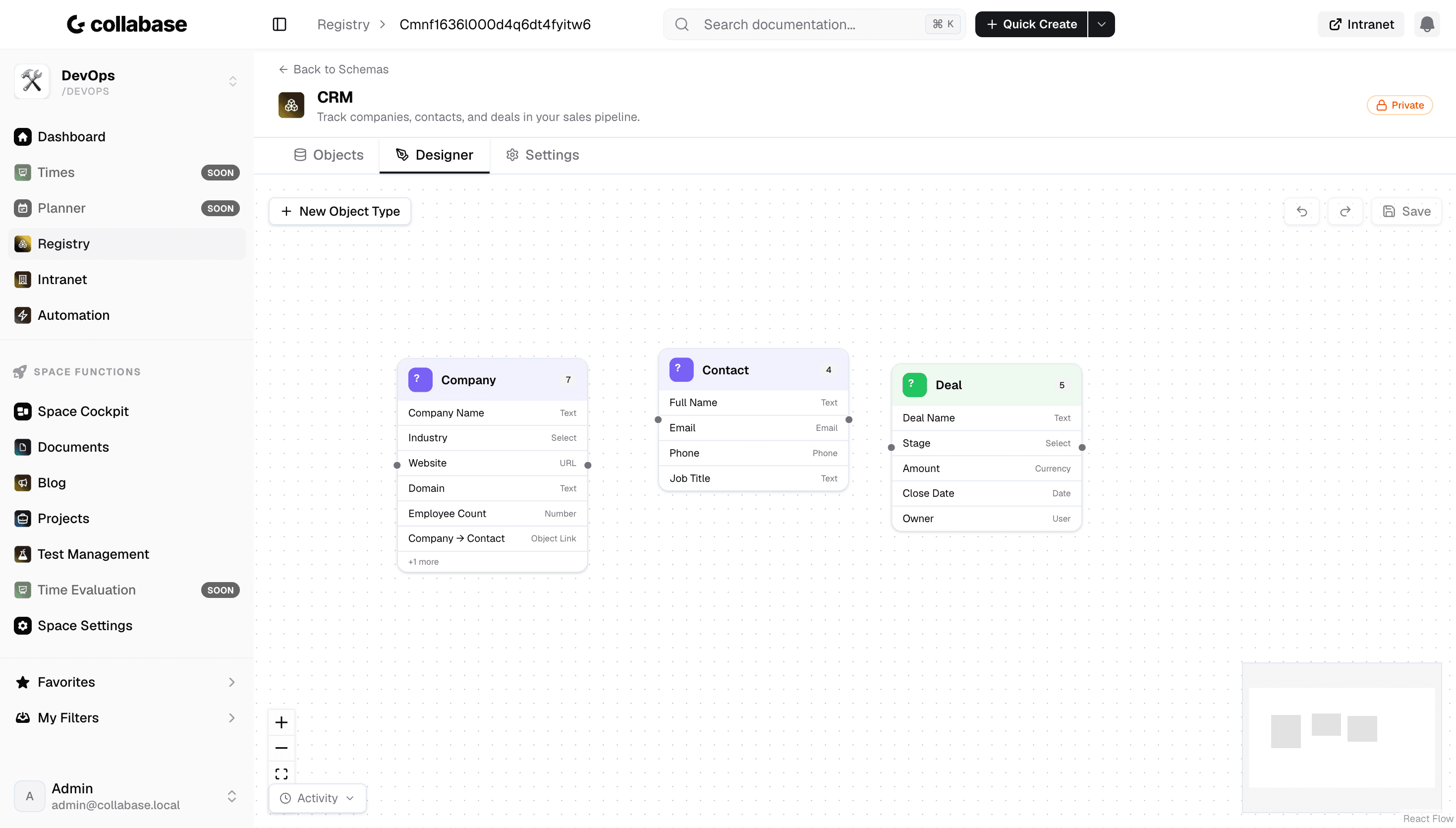
Data model in the browser
Objects, fields and relationships are built in the visual designer. Changes go live immediately, without a database migration and without a deployment.
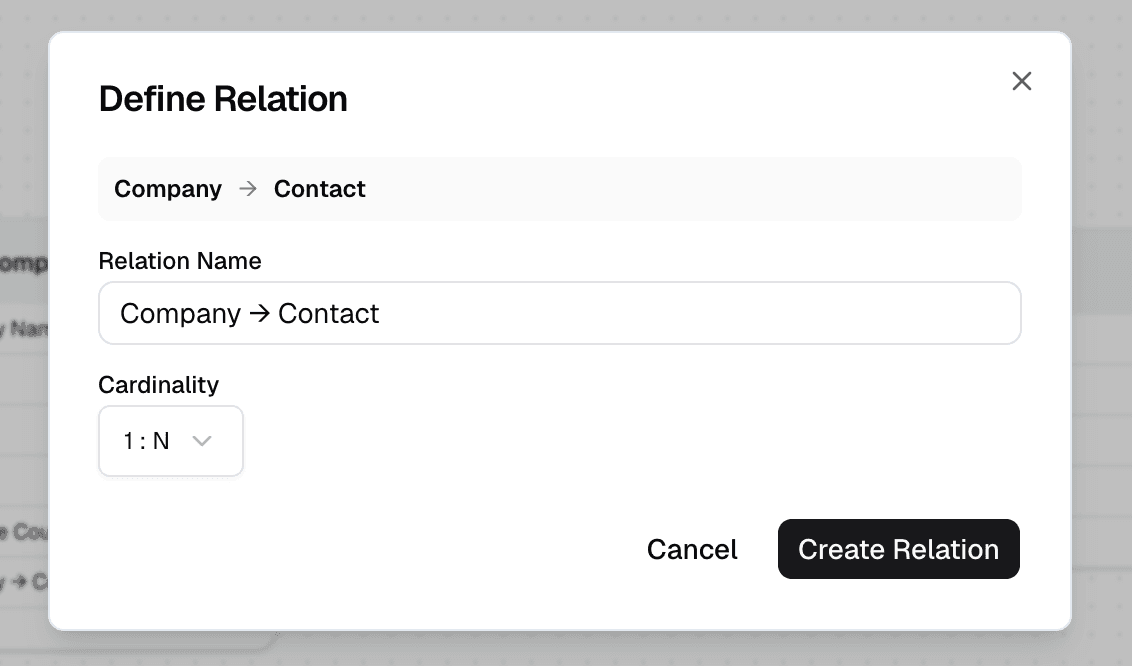
Relational links, visible both ways
Objects are linked through 1:1, 1:n and n:m fields. Every relationship is visible from both sides, without anyone maintaining it twice.
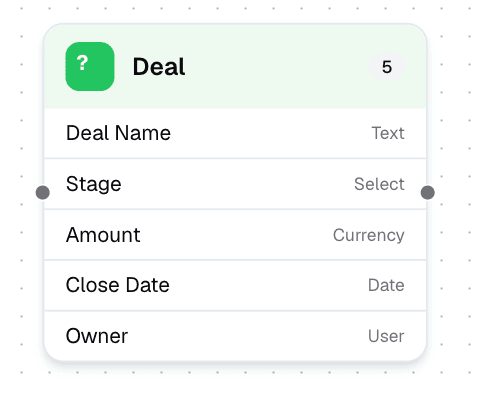
Layouts per business unit
The page builder decides which fields are visible in which order, per object and per role. Sales sees different fields than accounting, and still there is only one database underneath.
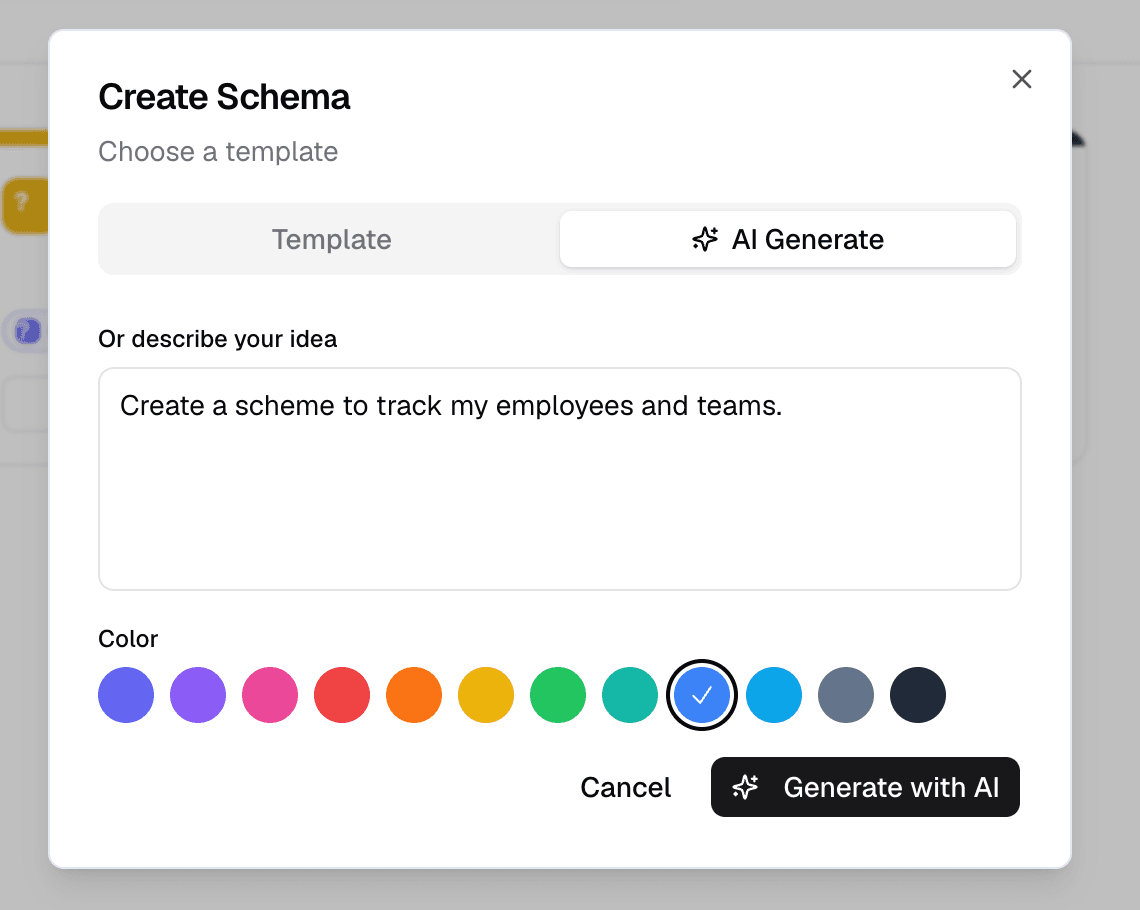
A schema from your description
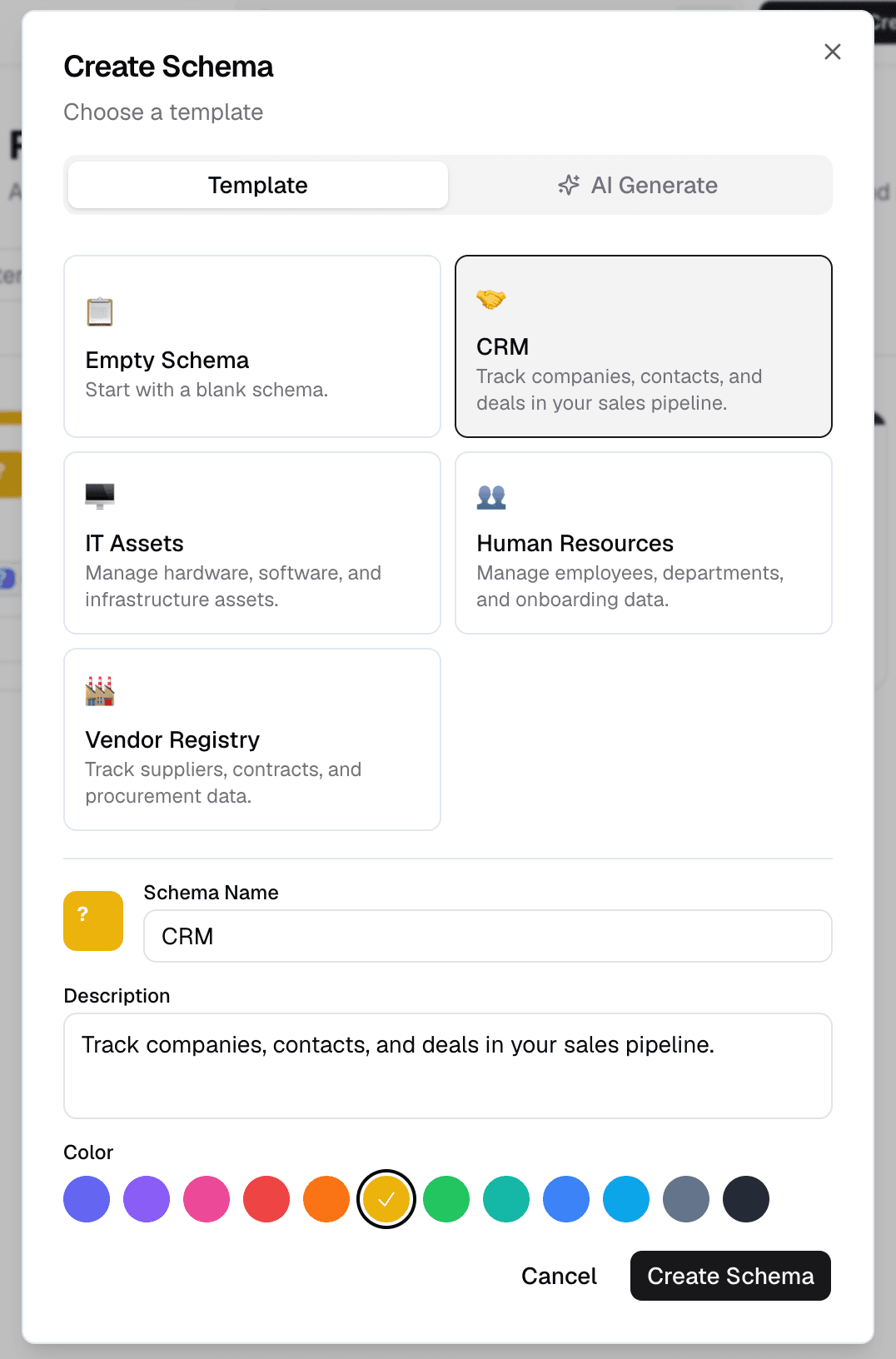
Describe in one sentence what you need, for example a customer list with contacts, contracts and invoices. Registry proposes a matching data model with sample data, and you adjust it visually.
Templates for common cases
Over 50 templates for CRM, asset management, applicant management, fleet management and inventory. You start from a model, not from an empty database.
Where it pays off.
CRM & sales
Accounts, contacts, opportunities and activities in one place.
Asset management
Hardware, licences and vehicles including maintenance history.
Product catalogues
Articles, prices, stock and suppliers with relationships.
Applicant management
Talent pool, interview rounds and ratings per position.
Registry is one app of seven.
Records from Registry can be referenced in Docs, created or updated by the Automation Engine and attached to a task in Projects. Every app shares login, permissions and data. One contract, one deployment, one contact.

Docs

Projects

Intranet

Registry

Test Management

Automation

Time
Operations and data sovereignty.
Where the data sits is decided by the operating model, not by the small print.
Swiss hosted
Operated on Swiss public cloud at Infomaniak, one isolated environment per customer. Content is processed in Switzerland only, apart from the upstream web application firewall.
Self-hosted
Runs on your own infrastructure. Full control over the data, no access from outside.
revFADP & GDPR
Data processing agreement included. Compliant with the revised Swiss data protection act and the GDPR.
One product, all apps.
Collabase Enterprise
On request
Staged by user count
Registry is part of the Enterprise plan. All seven apps, no add-ons.
Questions from first conversations.
Registry in practice: what comes up most often in a first conversation.
Do we need developers to build our own data model?
No. Object types, fields and relationships are created in the browser through the schema designer. Departments build their own model without waiting for a slot on the IT roadmap.
How granular can permissions be?
Down to individual fields. A record can be visible to a group while single fields inside it are not. That is the difference from permissions that only know whole tables.
Is there an interface for other systems?
A REST API and webhooks are available from the first record, with no additional module. Every object type can be read and written through them, and changes to records can trigger automations.
How does existing data get in?
Through CSV import. More than 50 templates are available as a starting point, among them CRM, asset management, applicant tracking and inventory.
Rebuild one of your spreadsheets in Registry.
In the proof of concept we move one of your productive spreadsheets into Registry, including roles, validation and API access.